
Risk management professionals know that a loan going bad is only one chapter in a much longer story. The full narrative of financial institution risk spans operational failures, regulatory breaches, market volatility, and liquidity shortfalls, each capable of inflicting serious damage with or without a single borrower defaulting. As regulatory expectations grow more exacting and emerging threats like cyberattacks and vendor model failures become normalized, CROs and risk teams at credit unions, community banks, and lenders need a structured, forward-looking command of every risk category their institution faces. This guide maps those categories, anchors them in current regulatory frameworks, and closes with actionable mitigation steps you can apply immediately.
Table of Contents
- Core types of risk in financial institutions
- Credit risk management: Principles and Basel frameworks
- Operational and compliance risk: Threats and oversight
- Liquidity and market risk: Meet regulatory benchmarks
- Practical steps for mitigating financial institution risk
- Why textbook compliance is not enough: A practitioner's warning
- Take your risk management beyond the rulebook
- Frequently asked questions
Automate Regulatory Model Risk Governance
Examine models against 32 qualitative criteria and resolve risk Tiers with pre-deployment checklists per OCC 2011-12 guidelines.
Key Takeaways
| Point | Details |
|---|---|
| Risk is multi-dimensional | Financial institutions face not just credit risk but also market, operational, liquidity, and compliance risks. |
| Basel frameworks are foundational | Effective credit risk management requires stress testing and forward-looking models aligned with Basel standards. |
| Operational and compliance risk is rising | Fraud, cyber threats, and regulatory pressure elevate operational and compliance risks. |
| Data and model governance is critical | Ongoing monitoring, model validation, and data centralization underpin robust risk management. |
| Practical application outperforms theory | Real-world resilience comes from proactive tools, scenario testing, and embedding risk awareness beyond compliance teams. |
Core types of risk in financial institutions
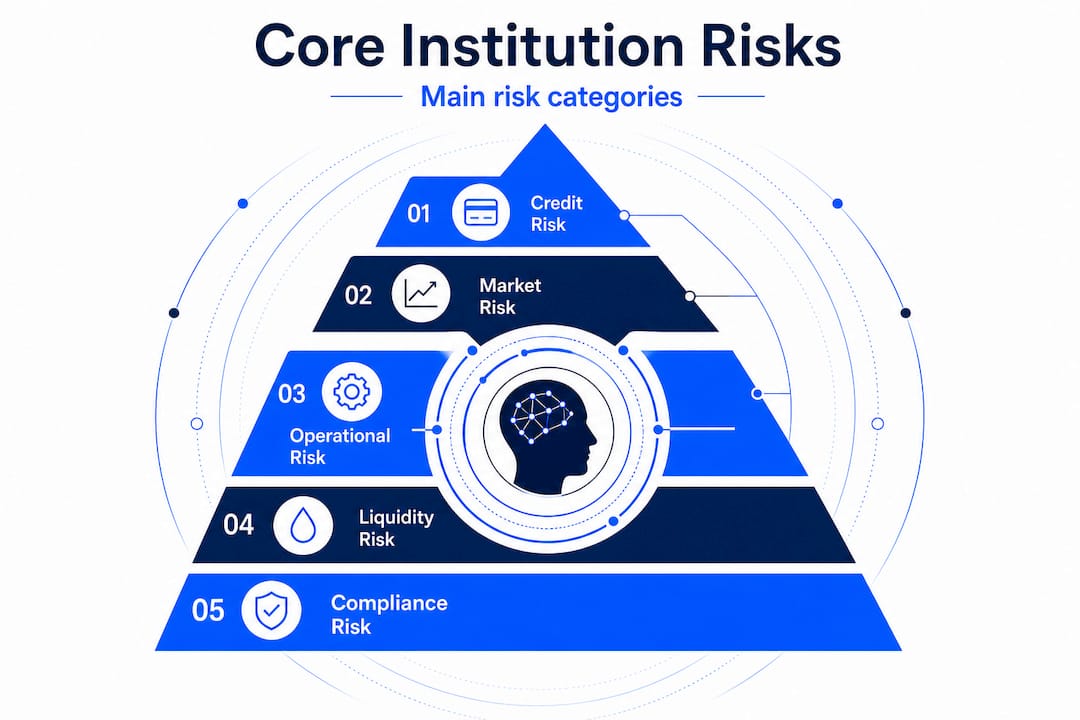
Many risk professionals enter the field focused almost entirely on credit. That focus is understandable given that loan losses historically drive capital impairment, but modern financial institution risk is far broader than any single category. Financial institution risk encompasses credit risk from borrower default, market risk from price fluctuations, operational risk from internal failures and fraud, liquidity risk from funding shortfalls, and compliance risk from regulatory violations, and these categories rarely operate in isolation.
The interrelated nature of risk is what makes category-level understanding so important. A cyber event, classified as operational risk, can trigger a liquidity crisis if customers lose confidence and begin withdrawing funds. A compliance failure tied to BSA/AML can draw regulatory action that constrains market activity. Understanding compliance in institutions means recognizing how one exposure can cascade into another.
| Risk type | Primary source | Potential impact |
|---|---|---|
| Credit risk | Borrower default, concentration | Loan losses, capital erosion |
| Market risk | Interest rate, FX, equity price shifts | Portfolio value decline |
| Operational risk | Fraud, cyber, process failure | Financial loss, reputational damage |
| Liquidity risk | Funding shortfall, deposit outflows | Inability to meet obligations |
| Compliance risk | Regulatory violations, BSA/AML gaps | Fines, enforcement, reputational harm |
Key exposures within each category include:
- Credit risk: Concentrated loan books, underwriting weaknesses, collateral deficiencies
- Market risk: Duration mismatches, unhedged interest rate exposure, foreign exchange positions
- Operational risk: Insider fraud, third-party vendor failures, system outages
- Liquidity risk: Over-reliance on short-term wholesale funding, deposit concentration
- Compliance risk: Inadequate monitoring programs, consumer protection lapses, AML control gaps
This taxonomy is not simply academic. Regulators use it to structure examination frameworks, capital requirements, and supervisory expectations, making it the common language between institutions and their overseers.
Credit risk management: Principles and Basel frameworks
Credit risk remains the largest single driver of minimum required capital for most institutions, and the frameworks governing it have grown considerably more rigorous since the 2008 financial crisis. Credit risk management follows Basel Principles covering the credit risk environment, the granting process, administration and monitoring, and controls, with current guidance placing heavy emphasis on stress testing, forward-looking macroeconomic factors, and portfolio-level assessment under adverse scenarios.

The shift toward Expected Credit Loss (ECL) models represents perhaps the most significant methodological evolution in recent years. Unlike backward-looking incurred loss models, ECL requires institutions to estimate losses over the life of a loan using current conditions and forecasted macroeconomic variables. This means your credit risk team must continuously validate model inputs, not just model structure. A strong approach to credit portfolio risk assessment requires layering multiple methodologies rather than trusting any single output.
The four Basel credit risk management pillars, mapped to modern practice, look like this:
| Basel principle | Modern enhancement |
|---|---|
| Credit risk environment | Board-approved appetite, strategic alignment |
| Granting process | ECL-integrated underwriting, forward-looking scoring |
| Administration and monitoring | Continuous portfolio surveillance, early warning indicators |
| Controls and oversight | Independent validation, stress testing, BCBS 239 data governance |
A disciplined approach to modern credit risk modeling now involves multiple scenario families, including baseline, adverse, and severely adverse economic paths, validated against historical performance and current market data. Portfolio stress testing goes beyond individual loan analysis to assess how correlated exposures behave when macroeconomic conditions deteriorate simultaneously.
Effective credit risk mitigation strategies for community banks and credit unions typically include:
- Setting concentration limits by sector, geography, and borrower type
- Implementing granular collateral valuation processes with independent appraisals
- Deploying early warning systems that flag delinquency indicators before default
- Running annual and event-triggered stress tests aligned with Basel guidance
- Maintaining model inventories with documented assumptions and validation schedules
Pro Tip: Do not rely on a single credit scoring model, even a highly accurate one. Layered approaches that combine statistical scorecards, rule-based overlays, and qualitative assessments produce more resilient credit decisions, particularly during economic inflection points when historical patterns break down.
Operational and compliance risk: Threats and oversight
Operational and compliance risks have moved from supporting roles to center stage in the modern risk landscape, driven by digitization, third-party dependencies, and an accelerating regulatory agenda. Operational risk is categorized into seven Basel event types: internal fraud, external fraud, employment practices and workplace safety, clients and products and business practices, damage to physical assets, business disruption and system failures, and execution and process management.
What is notable about the current environment is that several of these event categories are simultaneously elevated. The OCC reports operational risk elevated due to fraud, cyber incidents, and third-party exposure, while compliance risk is heightened by BSA/AML deficiencies and consumer protection issues.
"Financial institutions face an elevated and complex risk landscape that requires proactive, adaptive risk management programs rather than periodic, checklist-based approaches." OCC Semiannual Risk Perspective, Spring 2025
Understanding the breadth of compliance risks in banking requires acknowledging that regulatory requirements are not static. BSA/AML rules, consumer financial protection standards, and data privacy regulations all evolve, sometimes faster than internal compliance programs can adapt. Compliance risk management involves firmwide programs built around risk assessments, monitoring and testing calibrated to business activity risk, and oversight by a corporate compliance function with genuine independence from the lines of business it reviews.
Practical exposures risk teams should be tracking include:
- Fraud risk: Synthetic identity fraud, check fraud, and business email compromise are all increasing, often targeting institutions with weaker controls
- Cyber risk: Ransomware attacks against financial institutions have grown in frequency and sophistication, with third-party technology providers representing a significant vector
- Vendor risk: Vendor model failures or data breaches through third parties can create liability even when your institution's own controls are sound
- Consumer compliance: Fair lending, UDAAP (Unfair, Deceptive, or Abusive Acts or Practices), and overdraft practices remain high-priority examination targets
Effective compliance monitoring best practices include separating risk assessment functions from oversight functions, running continuous transaction monitoring rather than periodic sampling, and conducting annual compliance risk assessments that map regulatory requirements to specific business activities.
Pro Tip: Third-party and vendor risks require validation steps your institution may not apply to internal tools. Before relying on any vendor model, document its limitations, test it against your own portfolio data, and establish contractual rights to audit model performance. Regulators increasingly expect this level of diligence, and building trust through compliance means extending that standard to every tool your institution uses.
Liquidity and market risk: Meet regulatory benchmarks
Liquidity and market risk are the categories most directly shaped by macroeconomic forces, and their management is heavily anchored in quantitative benchmarks established under Basel III. These benchmarks exist because the global financial crisis demonstrated that even well-capitalized institutions could fail quickly if they could not fund their obligations or liquidate positions without significant loss.
Basel III benchmarks show that Group 1 banks currently maintain a Common Equity Tier 1 ratio of approximately 13%, a Liquidity Coverage Ratio of 134.8%, and a Net Stable Funding Ratio of 123.7%, with non-securitization credit risk accounting for roughly 70% of minimum required capital and operational risk representing approximately 16%.
| Metric | Basel III minimum | Industry average (Group 1) |
|---|---|---|
| CET1 ratio | 4.5% (plus buffers) | ~13% |
| Liquidity Coverage Ratio (LCR) | 100% | 134.8% |
| Net Stable Funding Ratio (NSFR) | 100% | 123.7% |
| Operational risk (% of MRC) | N/A | ~16% |
Understanding regulatory risk tolerance (RRT) adds an important behavioral dimension to these numbers. Post-GFC research shows that banks with high regulatory risk tolerance cut lending when capital buffers are depleted, while low-RRT institutions tend to adjust asset risk instead. This distinction matters because it reveals that capital ratios alone do not predict institutional behavior. Culture, appetite frameworks, and leadership priorities all shape how your institution responds when headroom narrows.
The practical steps for monitoring liquidity and market risk include:
- Maintaining a robust contingency funding plan with tested triggers and escalation protocols
- Running interest rate risk in the banking book (IRRBB) scenarios under both parallel rate shifts and non-parallel yield curve changes
- Tracking LCR and NSFR daily rather than at quarter-end to avoid surprise shortfalls
- Engaging board-level review of regulatory benchmarks insights and capital adequacy quarterly, not just during examination cycles
The 16% share of capital allocated to operational risk deserves particular attention for community institutions, where operational losses, though smaller in absolute terms, can represent a proportionally larger share of capital. Investing in operational controls is not just a compliance requirement. It is a capital efficiency strategy.
Practical steps for mitigating financial institution risk
Mapping risk categories and understanding regulatory frameworks is necessary but not sufficient. The discipline of risk management ultimately lives in what your institution does every day, not in what your policies say. Basel updates emphasize forward-looking ECL models, stress scenarios applied across the credit lifecycle, and BCBS 239 data aggregation as foundational requirements for effective credit risk oversight.
Here is a practical playbook for translating frameworks into operational reality:
- Establish independent validation for every model in your institution's risk inventory, including models provided by third-party vendors, with documented assumptions, known limitations, and periodic performance benchmarking
- Integrate ECL and stress testing workflows so that scenario outputs feed directly into loan loss reserve calculations, credit appetite decisions, and capital planning processes
- Shift from annual to continuous monitoring by implementing automated data feeds, real-time dashboards, and exception-based alerts that surface risk changes as they emerge rather than at review cycles
- Achieve BCBS 239 compliance by centralizing risk data aggregation, ensuring data lineage is documented, and eliminating manual, spreadsheet-based reporting processes that introduce error and latency
- Embed risk accountability in business lines by assigning first-line risk owners, training staff on risk identification, and creating feedback loops between risk outcomes and business decisions
Advanced tools for ongoing oversight include:
- Automated early warning systems tied to macroeconomic indicator feeds
- Real-time transaction monitoring for fraud and AML anomaly detection
- AI-assisted model validation platforms that flag performance drift between validation cycles
- Portfolio concentration heat maps updated continuously as the loan book evolves
- Scenario libraries that allow teams to run custom stress events within hours rather than weeks
The case for automated risk management is not about replacing expert judgment. It is about giving experts the real-time information they need to exercise that judgment effectively. Institutions that still rely on quarterly spreadsheet reports are, by definition, managing yesterday's risk. The most resilient community banks and credit unions we see today have adopted AI frameworks for risk that allow continuous oversight without proportional increases in staffing.
Why textbook compliance is not enough: A practitioner's warning
Here is an uncomfortable truth that most framework documents will not say directly: meeting regulatory minimums does not mean your institution is safe. It means you have satisfied the documented standard at a point in time, and the gap between that standard and actual resilience can be significant.
The research on high-RRT versus low-RRT banks illustrates this sharply. Institutions that operated at the higher end of regulatory tolerance before a capital buffer depletion event were the ones that cut lending most aggressively when conditions tightened, because their risk culture had never internalized caution as a default posture. The controls were present. The culture was not aligned with them.
Vendor model failure is another example where regulatory templates consistently lag reality. Your institution may have documented validation processes for internally built models, but have you applied the same rigor to the scoring tool your core provider embedded in the underwriting workflow three years ago? Examiners are beginning to ask exactly this question, and the answer at many institutions is revealing.
The institutions that consistently outperform on risk-adjusted returns are not those with the thickest policy manuals. They are the ones where risk thinking is embedded in relationship managers, loan officers, and technology teams, not just in the compliance department. That embedding requires investment in training, audit quality, technology that surfaces risk in real time, and genuinely curious people who ask uncomfortable questions before examiners do.
Automation in risk management earns its value precisely by freeing senior risk professionals from routine data assembly so they can focus on the interpretation and judgment that no checklist can replace. True resilience is built by institutions that use regulatory frameworks as a floor, not a ceiling.
Take your risk management beyond the rulebook
The gap between meeting Basel requirements and genuinely controlling institutional risk is where leading financial institutions differentiate themselves, and where technology makes the greatest difference.
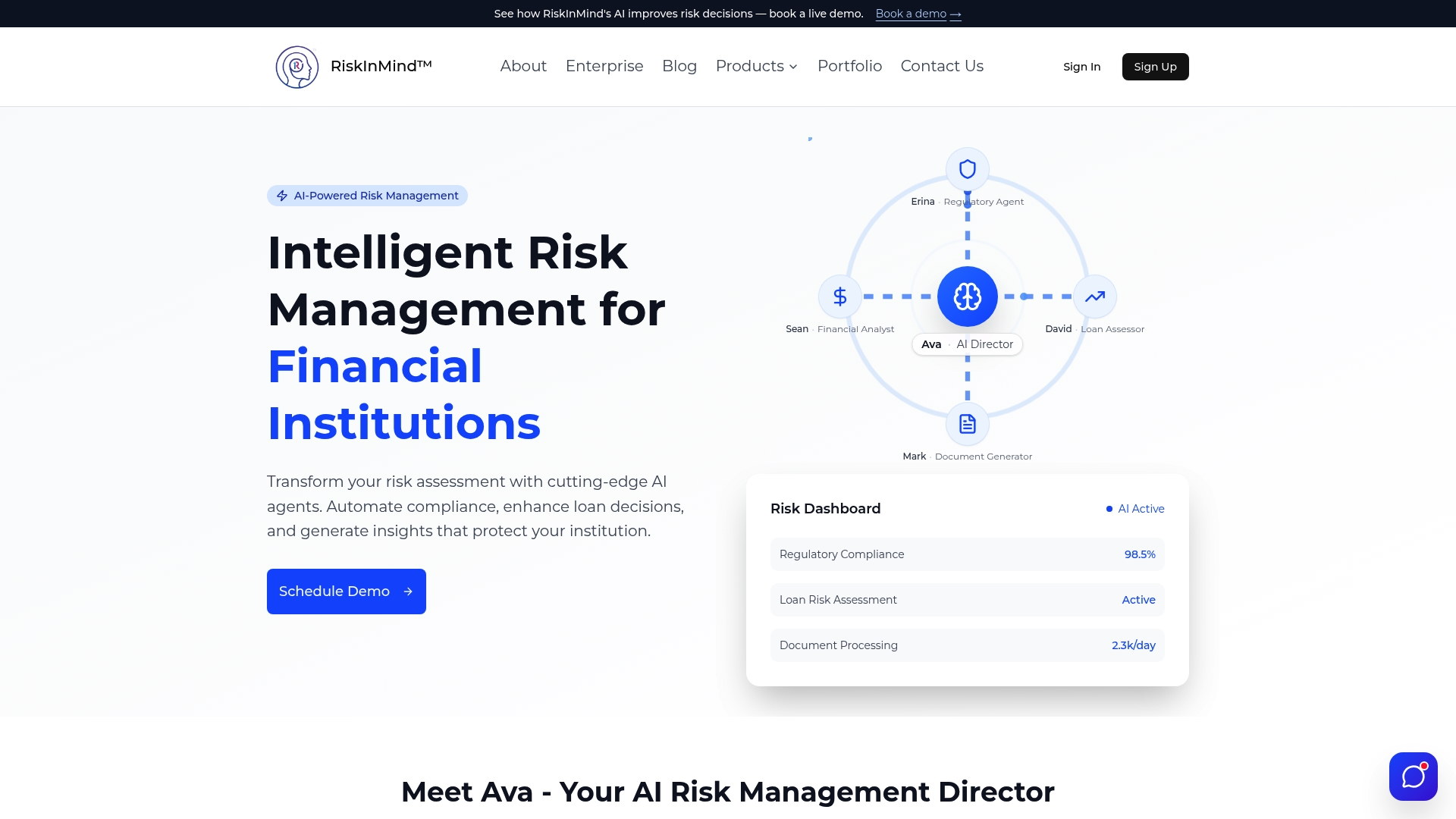
RiskInMind's AI-powered risk management platform is built specifically for credit unions, community banks, and lenders that need real-time visibility across credit, compliance, and operational risk without adding proportional overhead. Ava, our central AI director, coordinates specialized agents covering regulatory compliance, credit risk assessment, and market analysis, delivering continuous oversight with response times under half a second. Whether you are stress-testing your loan portfolio, monitoring for BSA/AML anomalies, or validating third-party models, our platform connects the frameworks you already know to the automation your team needs. Explore our AI loan assessor or review risk solution pricing to see how we align with your institution's requirements.
Frequently asked questions
What are the main categories of risk in financial institutions?
The core categories are credit, market, operational, liquidity, and compliance risk, each with distinct sources and regulatory treatment. As the Basel guidance confirms, these categories span borrower default, price fluctuations, internal failures, funding shortfalls, and regulatory violations.
Why has operational risk become more prominent recently?
Operational risk has risen sharply due to increased fraud, cyberattacks, and third-party vendor exposures that were not present at the same scale a decade ago. The OCC's 2025 Risk Perspective identifies these factors as the primary drivers of current operational risk elevation.
How are banks expected to assess credit risk today?
Banks now apply stress testing, forward-looking ECL models, and portfolio-level assessment under adverse macroeconomic scenarios as standard practice. Basel Principles require that credit risk programs cover the full lifecycle from environment and granting through administration, monitoring, and control.
What is regulatory risk tolerance and how does it influence banks?
Regulatory risk tolerance reflects how close to regulatory limits an institution is willing to operate and fundamentally shapes its lending and capital deployment decisions. Post-GFC research demonstrates that high-RRT banks curtail lending aggressively when buffers narrow, while low-RRT institutions make more gradual adjustments to asset risk.
What is the role of third-party model validation in risk management?
Independent validation of vendor-supplied models is essential to ensure that assumptions, limitations, and performance characteristics are fully documented and understood before those models influence risk decisions. Without this validation, institutions expose themselves to model risk that regulators increasingly hold them accountable for, regardless of whether the model was built internally or procured externally.
Recommended
- Top financial risk mitigation strategies for credit unions | RiskInMind
- Financial risk assessment: methods, models, and AI | RiskInMind
- Before Regulators Step In: Stopping Yonkers‑Style Failures with RiskInMind | RiskInMind
- Turning the First Bank Failure of 2026 Into a Warning Signal: How AI‑Driven Risk Management Could Have Saved Metropolitan Capital Bank & Trust | RiskInMind