
Financial risk assessment at community banks and credit unions is not a single calculation performed once a year before an exam. It is a continuous, multi-layered discipline that spans credit quality, liquidity buffers, operational controls, market exposure, and portfolio concentration, all evaluated simultaneously and often under regulatory scrutiny. The stakes are high: errors in risk quantification can trigger capital shortfalls, examination downgrades, or loan losses that erode member value for years. At the same time, the tools available for this work are evolving rapidly, with AI-powered platforms reshaping how institutions identify, measure, and respond to emerging risk signals in real time.
Table of Contents
- Understanding financial risk assessment
- Core methodologies for risk assessment
- AI-driven approaches in modern risk assessment
- Navigating edge cases and nuanced risk factors
- A fresh perspective: smart AI integration for community banks
- Optimize risk assessment with advanced AI solutions
- Frequently asked questions
Automate Regulatory Model Risk Governance
Examine models against 32 qualitative criteria and resolve risk Tiers with pre-deployment checklists per OCC 2011-12 guidelines.
Key Takeaways
| Point | Details |
|---|---|
| Multi-layered risk analysis | Effective financial risk assessment covers credit, liquidity, operational, and concentration risks with various models and frameworks. |
| AI integration improves accuracy | Using AI tools for risk assessment enables faster, more precise analysis but requires robust model oversight to avoid errors. |
| MRM and qualitative overlays | Independent validation, strong governance, and expert input are essential for managing complex or edge-case risks. |
| Stress-testing for concentration risk | Advanced analysis and stress tests mitigate portfolio concentration risks in community banks and credit unions. |
| Scalable solutions for compliance | Prioritizing practical, scalable models and cautious AI adoption ensures regulatory compliance and sustainable risk management. |
Understanding financial risk assessment
Financial risk assessment in banking is the structured process of identifying exposures that could impair an institution's financial condition, quantifying the likelihood and severity of those exposures, and implementing controls to keep risk within board-approved tolerances. It is not a compliance checkbox. It is the analytical backbone of every lending decision, capital allocation, and strategic plan your institution produces.
The main risk categories that financial risk assessment targets include:
- Credit risk: The probability that a borrower will fail to meet contractual obligations, resulting in charge-offs or delinquencies that reduce net interest margin and capital.
- Liquidity risk: The exposure to funding shortfalls, particularly when deposit outflows or loan demand exceed available liquid assets, as seen in several regional bank failures in recent years.
- Operational risk: Losses arising from failed processes, systems, or human errors, including cybersecurity breaches and vendor failures.
- Market risk: The sensitivity of asset and liability values to changes in interest rates, exchange rates, or equity prices, most relevant in investment portfolios and mortgage books.
- Concentration risk: Overexposure to a single borrower, sector, or geography that amplifies losses when that segment deteriorates.
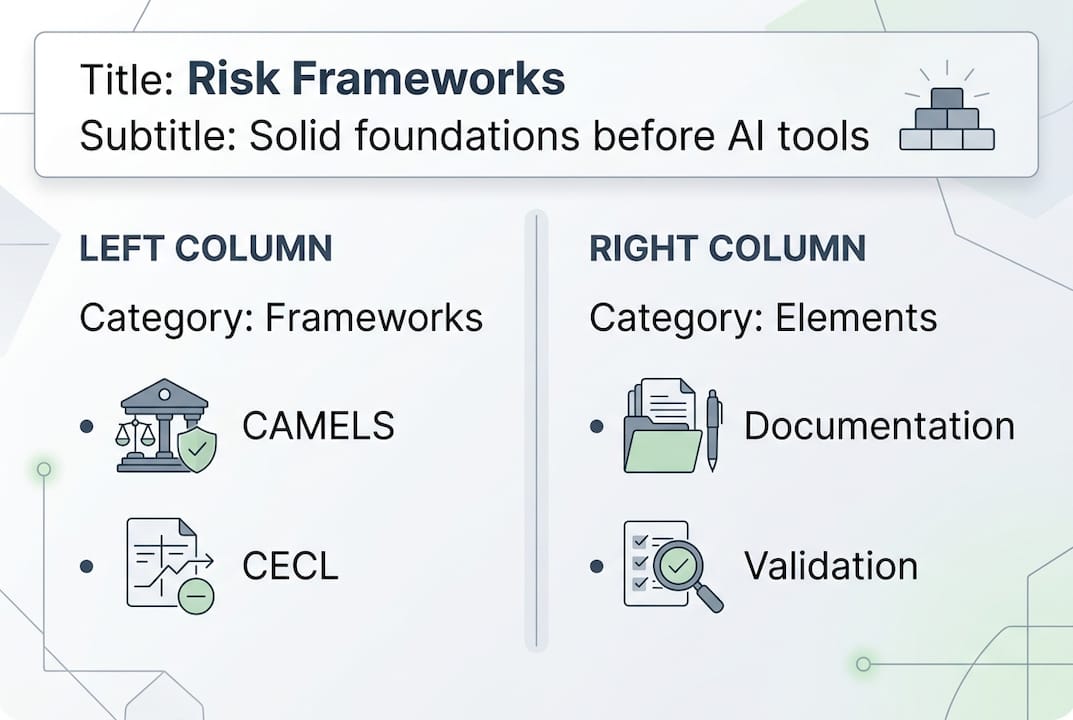
For regulatory supervision, the most recognized framework remains the CAMELS system. CAMELS ratings cover capital adequacy, asset quality, management capability, earnings performance, liquidity, and sensitivity to market risk. Examiners use composite CAMELS scores to prioritize examination resources and to signal whether corrective action is needed. A rating of 1 or 2 indicates satisfactory performance, while scores of 4 or 5 reflect serious deficiencies requiring immediate attention.
Understanding strong risk management frameworks is the foundation before any AI tool can be used effectively, because automated systems must operate within governance structures that reflect well-defined risk appetite and control standards.
Pro Tip: Treat financial risk assessment as a living process rather than a periodic report. Institutions that update risk ratings monthly rather than quarterly catch deteriorating credits an average of two quarters earlier, giving management meaningful time to intervene before classified assets accumulate.
Examiners and auditors increasingly expect institutions to demonstrate not just that risk assessments were performed, but that findings drove actual decisions. That means documented policies, consistent rating methodologies, and clear escalation paths when risk thresholds are breached. Aligning daily risk practices with the expectations outlined in AI risk management best practices is becoming a competitive and regulatory necessity for institutions of every size.
Core methodologies for risk assessment
Building on the types of risk described above, community banks and credit unions employ several distinct methodologies to evaluate and quantify each exposure. The sophistication of the method selected should match the complexity of the portfolio and the institution's analytical capacity.

CAMELS-based evaluation remains the primary regulatory lens. Each component carries specific analytical expectations. Asset quality, for example, requires examiners to assess underwriting standards, pricing adequacy, problem asset management practices, and the adequacy of the Allowance for Loan and Lease Losses, or ALLL. The transition to CECL, the Current Expected Credit Loss standard, fundamentally changed how institutions measure ALLL by requiring lifetime loss estimation rather than incurred loss recognition.
The most widely used CECL methodologies for community institutions, as outlined in FDIC guidance on asset quality, include WARM (Weighted Average Remaining Maturity), Roll Rate, and Present Value of Cash Flows models. WARM is particularly practical for smaller institutions because it applies historical average annual charge-off rates adjusted for current economic conditions and remaining loan maturity, without requiring complex statistical infrastructure.
Here is a practical comparison of traditional versus AI-enhanced risk assessment methods:
| Method | Traditional approach | AI-enhanced approach |
|---|---|---|
| Credit scoring | Static FICO-based thresholds | Dynamic behavioral scoring with real-time data |
| CECL estimation | Historical averages, manual overlays | Machine learning loss forecasting with macro variables |
| Portfolio monitoring | Quarterly loan reviews | Continuous anomaly detection across full portfolio |
| Stress testing | Annual scenario analysis | On-demand multi-variable scenario modeling |
| Regulatory reporting | Manual data aggregation | Automated data extraction and report generation |
Reviewing risk analytics steps can help teams understand how each of these methods fits into a broader institutional workflow, from data collection through final reporting.
The numbered implementation sequence for a sound CECL process at a community bank or credit union typically follows this order:
- Segment the loan portfolio by product type, collateral class, and risk grade.
- Collect historical charge-off data by segment, ideally spanning a full economic cycle.
- Select the appropriate loss estimation methodology for each segment based on portfolio size and data availability.
- Apply qualitative adjustments for current conditions not captured in historical data.
- Document all assumptions, data sources, and management overlays for examiner review.
- Validate the model output against actual performance on a recurring basis.
For institutions with commercial real estate concentration, specialized tools like the CRE loan risk predictor can dramatically improve the precision of loss estimates by incorporating property-level cash flow dynamics alongside borrower financial data.
AI-driven approaches in modern risk assessment
Once familiar with standard methods, it becomes clear that AI is not replacing these frameworks but accelerating and deepening them. Machine learning models can process thousands of variables simultaneously, identifying non-linear relationships between borrower characteristics, economic indicators, and default probabilities that traditional logistic regression models miss entirely.
The core advantages AI brings to risk assessment include:
- Speed: AI can evaluate a loan application and generate a risk-tiered recommendation in under a second, compared to hours or days for manual review.
- Consistency: Unlike human analysts who may apply different standards across similar credits, AI applies the same logic to every file, reducing rating drift.
- Pattern recognition: Neural networks detect early warning signals, such as subtle cash flow fluctuations or delinquency roll-rate changes, well before they manifest as classified assets.
- Scalability: As portfolios grow, AI platforms scale without proportional increases in staff or processing time.
However, AI introduces its own category of risk: model risk. Model risk arises when an AI system produces incorrect, biased, or poorly calibrated outputs that drive flawed decisions. This can occur because of data quality issues, inappropriate model assumptions, or a model being applied outside the conditions it was built for. Model Risk Management requires a structured lifecycle that includes rigorous development standards, independent validation, ongoing performance monitoring, and strong governance to prevent these failures from reaching credit or compliance decisions.
The MRM framework that regulators expect involves several non-negotiable elements: clear documentation of model purpose and limitations, independent validation by staff or parties not involved in model development, regular backtesting against realized outcomes, and board-level oversight of model governance policies.
Pro Tip: Use MRM checkpoints before deploying any AI model into production, not after. Institutions that validate models post-deployment often discover calibration errors after real decisions have already been affected, creating both financial and regulatory exposure.
Exploring advanced AI risk strategies gives institutions a detailed roadmap for aligning AI deployment with MRM requirements, while guidance on how to automate risk assessment addresses the practical integration of automation into existing workflows. For institutions specifically interested in consumer and commercial lending improvements, understanding machine learning for credit assessment is a critical step toward more accurate and defensible underwriting decisions.
Navigating edge cases and nuanced risk factors
With robust standard processes in place, the next challenge is confronting the nuanced, edge-case risks that standard models often underestimate. These are the exposures that appear manageable under normal conditions but become critical during stress periods.
Concentration risk is one of the most consequential of these. A portfolio where a single borrower, industry sector, or geographic market represents an outsized share of total credit exposure is inherently fragile. Many community banks carry commercial real estate concentrations exceeding 300% of capital, a level that triggers heightened regulatory scrutiny and mandatory stress testing under interagency guidance. NCUA guidance on concentration risk makes clear that institutions must perform advanced portfolio analysis, apply sector-specific stress scenarios, and document management's awareness and mitigation strategies when concentration thresholds are approached or exceeded.
Inherent risk versus residual risk is another distinction that examiners expect institutions to understand and measure separately. Inherent risk is the gross level of exposure before any controls are applied. Residual risk is what remains after controls are factored in. Many institutions only assess residual risk in their reports, which masks the true underlying exposure and creates blind spots during rapid portfolio growth.
Vendor model pitfalls represent a growing concern as more institutions rely on third-party credit models or AI scoring systems. When a vendor model produces a rating, the institution using it remains fully accountable for that output under regulatory standards. Due diligence requirements include reviewing the vendor's model documentation, testing performance against the institution's own portfolio data, and conducting periodic independent validation rather than simply accepting vendor-provided validation reports.
Qualitative overlays are the expert judgment layer that prevents models from operating in a vacuum. When macroeconomic conditions shift rapidly, when a local employer closes, or when a specific loan pool exhibits characteristics not captured in training data, experienced credit officers must reinforce or override model outputs with documented rationale. The discipline of knowing when to apply an overlay and how much weight to give it is as important as the model itself.
"Credit unions must identify, monitor, and control concentrations to avoid significant losses that could threaten safety and soundness. Concentration management requires stress testing, qualitative analysis, and proactive board reporting." — NCUA Letter to Credit Unions on Concentration Risk
For institutions seeking a structured approach to managing these exposures, reviewing risk mitigation strategies provides concrete frameworks that align with regulatory expectations while remaining practical for institutions with lean risk teams.
A fresh perspective: smart AI integration for community banks
Here is what we have observed working with financial institutions across the country: the institutions that benefit most from AI are not the ones that implement it most aggressively. They are the ones that implement it most deliberately. There is a meaningful difference.
Community banks and credit unions that rush AI adoption without establishing MRM governance, without testing models against their own historical data, and without training staff to recognize when model outputs need a qualitative override, frequently discover that AI amplifies their existing data quality problems rather than solving them. A poorly calibrated loss model at 10,000 loans is a much larger problem than a poorly calibrated spreadsheet at 500 loans.
Our recommendation is to start with scalable, well-understood methods like WARM-based CECL with documented qualitative adjustments, then layer AI tools incrementally as governance infrastructure matures. The NCUA's simplified CECL tool demonstrates that smaller institutions can achieve CECL compliance with straightforward methods while still leaving room for AI-assisted enhancements as capacity grows. Independent validation, stress testing under adverse scenarios, and consistent expert overlay processes are not bureaucratic overhead. They are the controls that keep AI from becoming a liability rather than an asset.
Institutions ready to move toward more sophisticated AI integration will find that AI-powered risk intelligence is most effective when it supports and strengthens the human judgment at the center of sound credit culture, not when it attempts to replace it.
Optimize risk assessment with advanced AI solutions
If the methodologies and frameworks covered in this article represent where your institution needs to grow, RiskInMind offers the purpose-built tools to get there efficiently and with regulatory confidence.
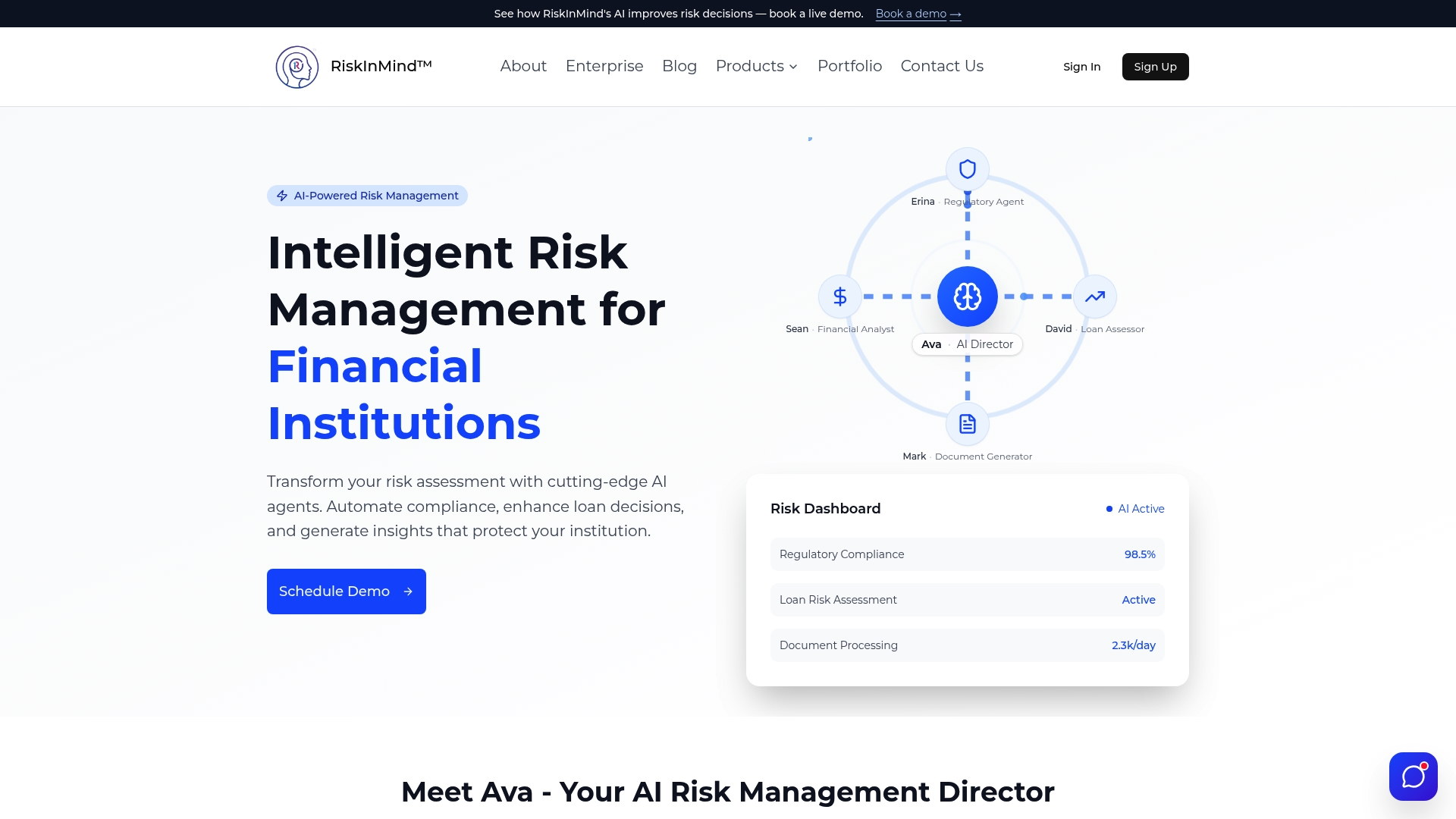
Our AI loan assessor delivers real-time credit evaluations with response times under half a second, applying risk grading logic consistent with MRM standards and CAMELS-aligned assessment criteria. The AI regulatory agent automates compliance monitoring and documentation, reducing the manual burden of regulatory reporting while maintaining the audit trail examiners expect. For cash flow analysis and income verification, the bank statement analyzer provides precise, repeatable outputs that support both underwriting accuracy and portfolio monitoring at scale. All solutions operate within RiskInMind's SOC 2 certified, bank-grade security environment.
Frequently asked questions
How does financial risk assessment differ from credit risk analysis?
Financial risk assessment covers a broader range of exposures, including credit, liquidity, market, and operational risks evaluated together, while credit risk analysis focuses specifically on the probability that a borrower will default on an obligation. The CAMELS framework captures capital, asset quality, management, earnings, liquidity, and sensitivity, demonstrating that regulatory expectations extend well beyond borrower default analysis alone.
What is the CAMELS rating system, and why is it important?
CAMELS is a supervisory framework that evaluates six components, covering capital adequacy, asset quality, management, earnings, liquidity, and sensitivity to market risk, with composite scores used by regulators to assess overall institutional safety and soundness. Per the FDIC's risk management guidance, CAMELS ratings directly influence examination frequency, corrective action requirements, and an institution's ability to pursue growth initiatives.
How do community banks implement CECL and WARM models?
Community banks typically apply historical average charge-off rates, adjusted for current conditions and remaining loan maturity, using the WARM methodology as described in FDIC asset quality standards, often supplemented by AI tools that improve forecast accuracy and reduce manual calculation error across loan segments.
What are the main risks with using AI for risk assessment?
AI models can produce incorrect or poorly calibrated outputs, particularly when applied to data distributions outside their training set, making independent validation and ongoing governance essential. The FDIC's Model Risk Management guidance requires institutions to document model limitations, validate independently, and monitor performance continuously to prevent model failures from affecting real lending or compliance decisions.
How can banks protect against concentration risk in loan portfolios?
Banks should apply sector-specific stress testing, maintain board-level reporting on concentration levels, and use qualitative overlays when model outputs do not fully capture sector-specific downside scenarios. NCUA concentration risk guidance specifies that portfolios with exposures exceeding established thresholds require documented mitigation strategies and enhanced monitoring protocols to satisfy safety and soundness standards.