
Selecting the wrong risk management tools doesn't just create operational headaches — it can compromise loan portfolios, invite regulatory scrutiny, and erode institutional trust built over decades. As regulators tighten expectations and financial risks evolve faster than ever, credit unions, community banks, and lenders are under real pressure to move beyond legacy systems. AI-driven platforms now promise stronger loan decisions, more accurate fraud detection, and streamlined compliance workflows. But the market is crowded, and not every solution delivers equal value. This guide breaks down the essential selection criteria, leading platforms, and decision frameworks you need to build a truly effective AI risk management stack.
Table of Contents
- How to evaluate risk management tools: Key selection criteria
- Top AI-powered risk governance platforms
- AI tools for loan underwriting and portfolio risk monitoring
- Side-by-side comparison of leading risk management tools
- Choosing the right tools for your institution's needs
- Why the future of risk management is hybrid AI — and what most experts miss
- Explore next-generation AI risk management solutions
- Frequently asked questions
Automate Regulatory Model Risk Governance
Examine models against 32 qualitative criteria and resolve risk Tiers with pre-deployment checklists per OCC 2011-12 guidelines.
Key Takeaways
| Point | Details |
|---|---|
| AI transforms risk management | AI tools enable financial institutions to strengthen oversight, boost underwriting accuracy, and stay compliant with evolving regulations. |
| Frameworks drive strong tool selection | Evaluating solutions against frameworks like NIST RMF ensures alignment with your organization’s policies and evolving risks. |
| Hybrid solutions offer the best results | Combining advanced AI with human expertise and clear processes delivers superior and more explainable risk outcomes. |
| Tool choice depends on institutional needs | Choosing the right tools means balancing model performance, regulatory fit, and integration with your current systems. |
How to evaluate risk management tools: Key selection criteria
Before comparing specific products, your institution needs a structured approach to evaluation. The selection process should begin with alignment to a recognized standard. The NIST AI RMF Core Functions define four foundational activities: Govern (establishing policies and oversight), Map (identifying risk contexts), Measure (assessing risk levels), and Manage (prioritizing and responding to risks). Using this framework as your baseline ensures that any tool you evaluate is benchmarked against industry standards for AI risk management rather than vendor marketing claims.
Here are the core criteria to apply systematically:
- Model explainability: Regulators and internal audit teams increasingly expect documented reasoning behind AI-generated decisions, especially for credit approvals and denials.
- Ongoing monitoring capabilities: A tool that performs well at launch but drifts over time creates hidden risk. Prioritize platforms with built-in model drift detection.
- Regulatory compliance alignment: Verify that the tool supports relevant frameworks, including the EU AI Act, NIST AI RMF, and applicable federal banking regulations.
- Scalability and integration: Assess whether the solution integrates cleanly with your core banking system, data warehouses, and reporting tools without requiring expensive middleware.
- Lifecycle support: Risk environments change. Select tools built for continuous recalibration as regulations and portfolio compositions evolve.
Pro Tip: Request a vendor's model validation report before any pilot. If they cannot provide third-party documentation of explainability and drift performance, treat that as a significant red flag.
Institutions that skip this structured evaluation frequently end up with point solutions that create integration debt and compliance gaps. The framework above is not bureaucratic overhead — it is your first line of defense against costly mistakes.
Top AI-powered risk governance platforms
With criteria defined, the next step is understanding which governance platforms best serve financial institutions navigating complex regulatory terrain. Several tools have earned strong reputations in this space, each with distinct operational strengths.
- Holistic AI: Designed for EU AI Act and NIST framework alignment, offering compliance auditing, risk scoring, and policy documentation for machine learning deployments.
- Credo AI: Specializes in policy workflow management, enabling compliance teams to track AI model behavior against internal governance standards and external regulations.
- Diligent: Focuses on risk benchmarking, drawing on a vast disclosure database of over 180,000 corporate filings to contextualize your institution's risk posture against peers.
- Arthur AI: Provides real-time drift and bias monitoring for both traditional ML models and large language models, making it particularly relevant as institutions begin deploying generative AI tools.
As noted in a comparative review of governance tools, these platforms are specifically tested for model monitoring, explainability, and regulatory alignment, distinguishing them from generic enterprise risk software. Institutions should also assess how these tools connect to broader risk automation strategies to understand their operational ceiling.
"AI governance is not a one-time certification — it is a continuous operating posture that demands tools capable of evolving alongside both regulatory requirements and model behavior."
For financial institutions that need regulatory risk coverage integrated directly into their workflow, RiskInMind's Erina regulatory risk agent provides real-time regulatory monitoring within a purpose-built financial risk platform. Broader operational efficiency can also be found by choosing to streamline your risk analysis processes at the platform level rather than layering disconnected point solutions.
Pro Tip: When evaluating governance platforms, ask specifically how each tool handles model re-validation after a regulatory update. Vendors that require manual re-audits for every change will create significant bottlenecks for your compliance team.
AI tools for loan underwriting and portfolio risk monitoring
Governance sets the foundation, but the loan and portfolio tools you deploy determine daily risk outcomes. The most effective underwriting AI currently in use draws on three primary model types:
- Random forest models: Highly effective for credit scoring because they can surface non-linear relationships between borrower attributes and default probability.
- Deep learning models: Excel at processing unstructured data, such as cash flow narratives and collateral documentation, making them valuable for commercial real estate and complex loan structures.
- Hybrid models: Combine the interpretability of tree-based methods with the pattern recognition depth of neural networks, often delivering the strongest performance for institutions balancing accuracy with explainability requirements.
The performance advantage of modern ML is material. Tree-based ML outperforms traditional quantile regression by 27% in tail risk forecasting, which translates directly into better identification of high-risk loan concentrations before they materialize as delinquencies.
However, there is a tradeoff worth acknowledging. Deep learning models can produce highly accurate risk scores that are difficult to explain to examiners or borrowers. This is not a reason to avoid them, but it is a reason to pair them with governance platforms that generate audit-ready documentation.
For ongoing portfolio monitoring, AI tools flag anomalies in real time: unexpected changes in debt service coverage ratios, geographic concentrations signaling sector stress, and early delinquency indicators that traditional batch-processing systems would catch far too late. RiskInMind's David loan assessor and Sean financial analyst agents are purpose-built for exactly these functions, while AI-driven CECL estimation capabilities further support accurate loss provisioning under current expected credit loss standards.

Side-by-side comparison of leading risk management tools
With detailed profiles covered, a comparison table clarifies each tool's unique role and where it performs best. These tools have been evaluated for monitoring and explainability across model governance and underwriting applications.
| Tool | Primary function | Regulatory alignment | Explainability | Best fit |
|---|---|---|---|---|
| Holistic AI | Governance and compliance | EU AI Act, NIST | High | Compliance-heavy institutions |
| Credo AI | Policy workflow management | NIST AI RMF | High | Institutions with complex governance structures |
| Diligent | Risk benchmarking | Broad disclosure standards | Medium | Board-level risk oversight |
| Arthur AI | Model drift and bias monitoring | NIST, internal policies | Medium | Institutions deploying ML and LLMs |
| RiskInMind (David) | Loan underwriting and credit risk | Banking regulators | High | Credit unions and community banks |
| RiskInMind (Sean) | Portfolio monitoring and analysis | Banking regulators | High | CROs managing multi-segment portfolios |
For institutions with significant commercial real estate exposure, the CRE Loan Risk Predictor adds specialized modeling capabilities that generic underwriting tools typically lack. Institutions can also reference the NIST RMF summary to validate alignment claims made by any vendor during procurement discussions.
The key takeaway from this comparison is that no single tool dominates all three functional categories: governance, underwriting, and portfolio monitoring. A well-designed stack typically combines a governance platform with purpose-built underwriting and monitoring agents.
Choosing the right tools for your institution's needs
Now that the strengths and trade-offs are clear, selecting your toolset is about fit and forward planning. Institution size, existing technology infrastructure, and regulatory exposure should all shape your approach.
- Assess your regulatory burden first: Heavily examined institutions, particularly those with over $1 billion in assets, should prioritize governance platforms with strong audit trail capabilities before expanding into advanced underwriting AI.
- Match tools to your tech stack: Avoid solutions that require rearchitecting your data pipeline. Prioritize APIs that connect to your existing core system.
- Start with a targeted pilot: Deploy new tools on a defined loan segment or regulatory reporting workflow before institution-wide rollout. Measure accuracy, processing time, and examiner feedback before scaling.
- Verify data privacy controls: Confirm that any AI tool you deploy meets your institution's data residency and privacy obligations, particularly if you handle sensitive borrower data across state lines.
- Plan for regulatory evolution: Continuous lifecycle application of the NIST RMF is the standard, not a one-time exercise. Build vendor contracts that include recalibration obligations as regulations change.
Smaller institutions often benefit from integrated platforms rather than best-of-breed point solutions. The overhead of managing multiple vendor relationships, API connections, and audit obligations can offset the performance gains. RiskInMind's AI enterprise solutions are specifically structured to address this reality for credit unions and community banks. For institutions evaluating credit documentation capabilities, AI credit memo tools can reduce documentation time significantly while maintaining examiner-ready quality.
Pro Tip: Before signing any vendor contract, request a regulatory change simulation. Ask the vendor to demonstrate how their platform would respond if a new compliance rule altered a key underwriting variable. Their answer reveals operational maturity more than any demo.
For additional context on how risk management principles apply across different asset classes, exploring crypto risk management applications highlights how automation principles transfer — and where the tolerance for opacity differs sharply from banking.
Why the future of risk management is hybrid AI — and what most experts miss
Most conversations about AI in financial risk management focus on model accuracy and processing speed. Those metrics matter. But the institutions that will genuinely win over the next decade are those that combine machine learning capability with rigorous human governance and policy discipline.
Hybrid ML models are strong in credit and fraud prediction but frequently lack the explainability required for regulatory scrutiny and board-level accountability. This is not a technology problem that will be solved by more data or faster processors. It is a governance problem, and it requires deliberate design.
Too many institutions treat AI adoption as a technology procurement exercise and skip the governance architecture entirely. The result is capable models operating without accountability structures, which creates regulatory exposure, not just operational risk. The institutions that learned the hard way from recent bank failures share a common thread: their risk frameworks were reactive, not proactive.
The most durable risk management stacks will not be the ones with the most sophisticated models. They will be the ones where AI capability, human judgment, and policy accountability operate as a coordinated system rather than competing layers.
Explore next-generation AI risk management solutions
For risk management professionals ready to move from evaluation to implementation, the right platform makes all the difference between compliance confidence and constant catch-up. RiskInMind brings together specialized AI agents for regulatory monitoring, credit risk assessment, loan underwriting, and portfolio analysis within a single, SOC 2® certified platform built specifically for financial institutions.
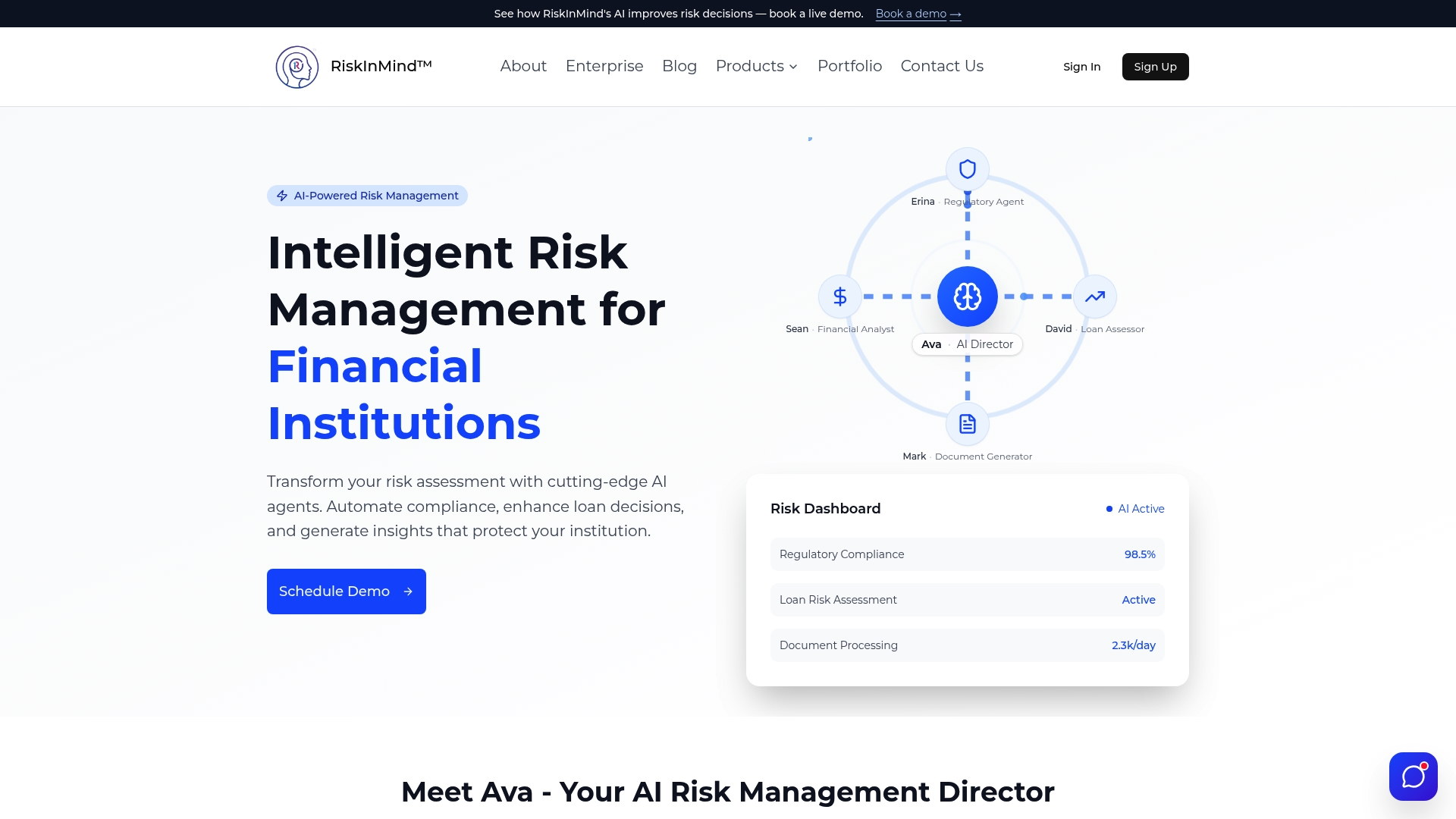
Whether you are a CRO at a growing credit union or a risk officer at a community bank managing increasing examination pressure, RiskInMind AI risk management offers the integrated toolset that replaces fragmented point solutions. Explore purpose-built capabilities including AI loan application tools that accelerate decisioning without sacrificing accuracy or examiner readiness.
Frequently asked questions
What is the difference between an AI risk governance platform and an underwriting tool?
AI risk governance platforms focus on model oversight, policy compliance, and regulatory alignment across your entire AI stack, while underwriting tools are purpose-built for evaluating borrower risk and informing loan approval decisions. Governance platforms such as Holistic AI and Credo AI are tested specifically for model monitoring, explainability, and regulatory alignment rather than loan-level decisioning.
How can NIST AI RMF help improve risk management tool selection?
The NIST AI RMF Core Functions provide a structured, universally recognized reference for mapping AI tools to organizational policies, operational risk contexts, and trustworthiness standards, making it far easier to compare vendors on a common baseline.
Why do machine learning models outperform traditional methods in risk prediction?
ML models detect complex, non-linear patterns across large datasets that linear regression approaches simply cannot capture. Random forests outperform traditional quantile regression by 27% in tail risk forecasting, which directly improves the identification of portfolio stress before it becomes loss.
What limits the adoption of advanced AI risk tools in financial institutions?
The primary barriers are explainability requirements for regulatory purposes, the cost and complexity of integrating AI tools with legacy core systems, and the pace of evolving regulatory standards. Hybrid ML models are powerful in credit and fraud prediction but still face scrutiny when institutions cannot articulate how a decision was reached.
Recommended
- RiskInMind - AI-Powered Risk Management Solutions
- Transforming Credit Union Growth with AI-Powered Risk Intelligence | RiskInMind
- Turning the First Bank Failure of 2026 Into a Warning Signal: How AI‑Driven Risk Management Could Have Saved Metropolitan Capital Bank & Trust | RiskInMind
- Streamline your risk analysis process for better compliance | RiskInMind